
Drive I-20 about 75 miles west of Fort Worth and, near exit 367, a tall brick smokestack rises beside the highway. It's one of the few things left of Thurber, a town that around 1918 to 1920 was home to an estimated 8,000 to 10,000 people and was the principal bituminous coal-mining town in Texas, according to the Texas State Historical Association's Handbook of Texas. The Handbook listed its population at eight in 2000.
Thurber sits just down the road from Mirador's Texas Shire Houses near Mingus, and its story is the backbone of this corner of North Texas. Here's how the town rose, why it emptied out and how to visit what remains.
Thurber at a glance
| Thurber | |
|---|---|
| Location | Northwest corner of Erath County, off I-20 at exit 367 |
| Mining begins | December 1886, under William Whipple Johnson and Harvey Johnson |
| Company town | Texas and Pacific Coal Company, from 1888 |
| Peak | An estimated 8,000 to 10,000 residents, 1918–20 |
| Known for | Coal, paving brick, and a 1903 union agreement |
| Decline | Railroads switched from coal to oil; the mines closed in the 1920s and the brick plant in 1930 |
| Today | A ghost town. The museum is open to visitors, and the town site is on the National Register of Historic Places |
Sources: TSHA Handbook of Texas; W.K. Gordon Center, Tarleton State University.
A town built behind a fence
Coal mining began here in December 1886 under brothers William and Harvey Johnson. The site was isolated, so the operators recruited miners from other states and from overseas. After the Johnsons failed to meet a payroll and the miners struck, the brothers sold out in the fall of 1888 to the founders of the Texas and Pacific Coal Company. They included Robert Dickey Hunter, who became the company's president, and H. K. Thurber of New York, the town's namesake.
The company's customer was the railroad. The Texas and Pacific Railway, running west from Fort Worth, needed coal for its steam locomotives, the W.K. Gordon Center explains.
Hunter dealt with the striking miners, who were affiliated with the Knights of Labor, "with an iron hand," in the Handbook's words. The company fenced part of its land and built a complete town inside it: schools, churches, saloons, stores, houses, an opera house seating more than 650, a 200-room hotel, an ice and electric plant, and the only library in the county. A stockade, armed guards and a barbed-wire fence controlled who came in. Pay came once a month, so workers often drew company scrip between paydays, reportedly discounted at 20 percent, to spend at the company's commissary stores.
Eighteen nationalities in one town
Because Thurber was so remote, the company recruited from far away. Large numbers of workers came from Italy, Poland, Britain and Ireland, as well as from across the United States, with smaller numbers from Mexico, Germany, France, Belgium, Austria, Sweden and Russia. The Gordon Center counts eighteen nationalities represented at Thurber. That mix of languages and traditions made it one of the most unusual communities in Texas.
The 1903 union town
For years, the company kept the unions out. That changed in 1903. In September, more than 1,600 miners joined the Thurber local of the United Mine Workers, and carpenters, brick makers, clerks, meat cutters and bartenders organized their own locals. On September 27, 1903, the company and the workers reached an agreement. The Handbook says Thurber became known as "the only 100 percent closed-shop city in the nation," and it remained a union stronghold until mining ended in the 1920s.
Make it part of a trip. Thurber is a short drive from Mirador. See the Texas Shire Houses and check dates for a night or two nearby.
Thurber brick
In 1897, a second industry arrived: a large brick plant. It used shale from company land and burned leftover "nut and pea" coal in its kilns. The plant reportedly produced 80,000 bricks a day and specialized in paving brick. According to the Gordon Center, Texas Almanac advertisements listed Thurber paving brick on the streets of Fort Worth, Dallas, Houston, Galveston and Beaumont. The ads also claimed Thurber brick for buildings in Fort Worth (the Texas and Pacific Railway station and the First National Bank) and in Dallas (the Dallas Opera House, among others).
Oil, and the end of Thurber
The same company engineer who modernized the mines helped end them. William Knox Gordon joined the company in 1889. Sure there was oil in the region, he pushed the company to drill near Ranger, where the J.H. McCleskey No. 1 blew in as a gusher in October 1917 and opened the Ranger oilfield. In 1918, the company renamed itself the Texas Pacific Coal and Oil Company.
Oil was good for the company and bad for the town. As railroads converted their locomotives from coal to oil, demand for Thurber coal fell. Wage cuts led to years of labor unrest and strikes in the 1920s, and the mines closed for good in 1926, according to the Gordon Center. The Handbook notes that by the end of 1927, no union miners remained in the state. Many miners left for mines in other states, and numerous Italian miners returned to Italy rather than work in nonunion mines.
As cheaper asphalt paving replaced brick and the Depression set in, the brick plant closed in 1930. The company moved its offices to Fort Worth in 1933, and the commissary stores closed in 1935. Many homes were sold and moved to surrounding towns, where some still stand. By the late 1930s, Thurber was a virtual ghost town.
Visiting Thurber today
Most of what remains of the old town sits on private property, so stick to public sites:
- W.K. Gordon Museum and Research Center. Run by Tarleton State University at the town site, at 65258 I-20 in Mingus (exit 367), it tells the story of the company town. It's open Tuesday–Saturday 10 a.m.–4 p.m. and Sunday 1–4 p.m., and closed Mondays. Admission is $5 for adults (12 and older), $4 for seniors and military, $2.50 for children 5–12, and free for children 5 and under. Parking is on-site, inside the museum gates.
- Historic buildings near the museum. The Thurber Historical Association moved a miner's home, the Catholic church and the top of the bandstand to a site next to the museum. It's open to the public for special events.
- The smokestack and the Mercantile. Across I-20, the Smokestack Restaurant takes its name from the 128-foot smokestack of the power plant that once supplied the town with electricity. After a 1992 fire, it was rebuilt in the north end of the old Texas & Pacific Mercantile, built with original Thurber brick in the late 1890s. It's open daily from 7 a.m., until 9 p.m. Sunday–Thursday and 10 p.m. Friday–Saturday.
Time it right: the museum is closed on Mondays, so plan a Tuesday-through-Sunday visit, and arrive by early afternoon to give yourself time before it closes. For more nearby stops and their weekday hours, see Things to Do Near Mingus, Texas on a Weekday.
Stay near Thurber
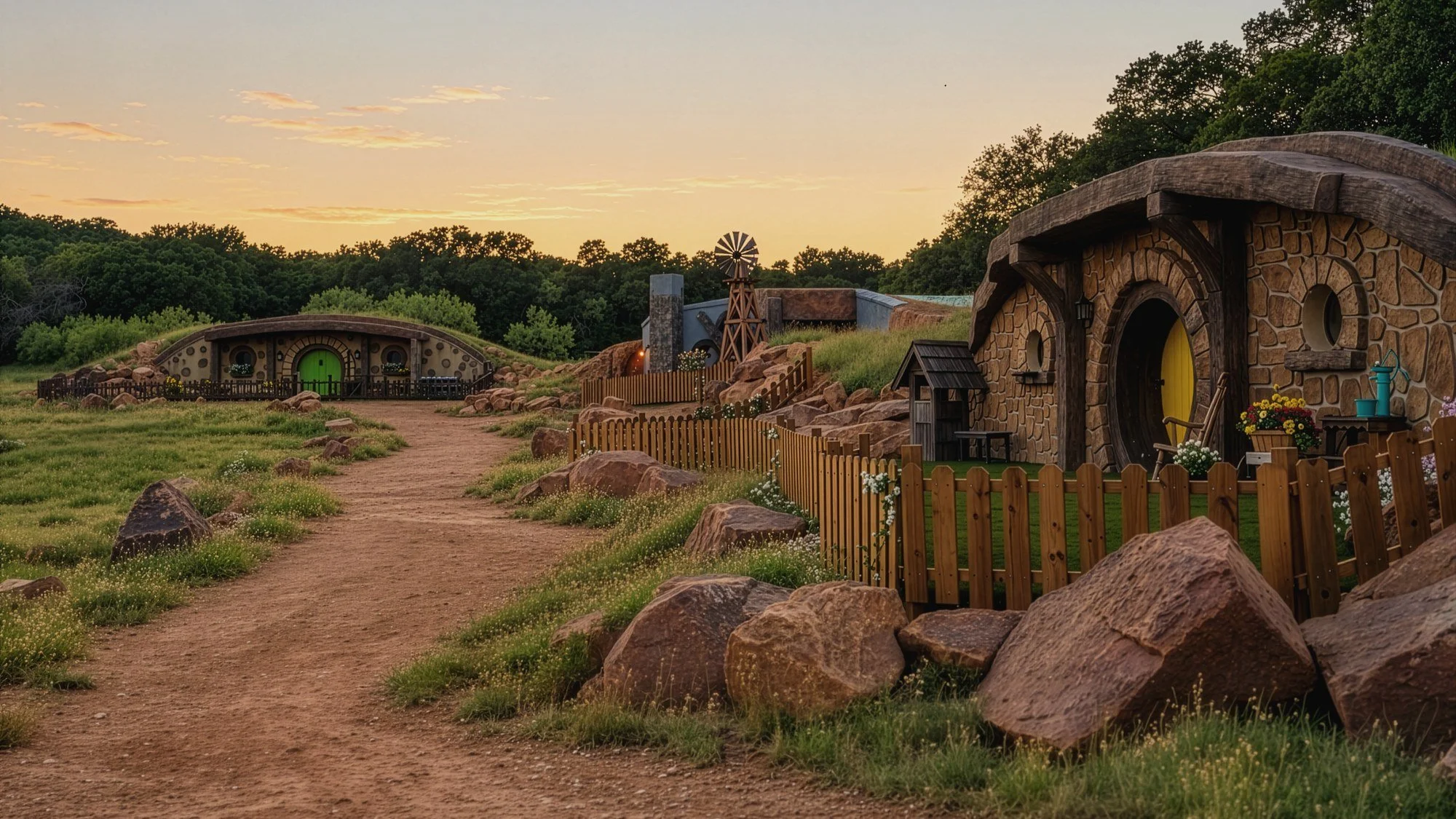
The railroad shaped Mingus, too. The Handbook notes that the town, just north of Thurber, grew up around the Texas and Pacific Railway's construction through the area in 1881.
Today, the hills around Mingus are home to Mirador's three hobbit-inspired Texas Shire Houses. A history day in Thurber pairs well with a quiet night in the Writer, the Gardener or the Baker House, the one that sleeps five. Each has a kitchenette with a stovetop, microwave, air fryer, sink and refrigerator. The Baker and Writer also have ovens, and the Gardener doesn't. Mirador's planned Coal Miner's Cave, a nod to Thurber's mining past, is coming soon and isn't bookable yet.
Make it an overnight
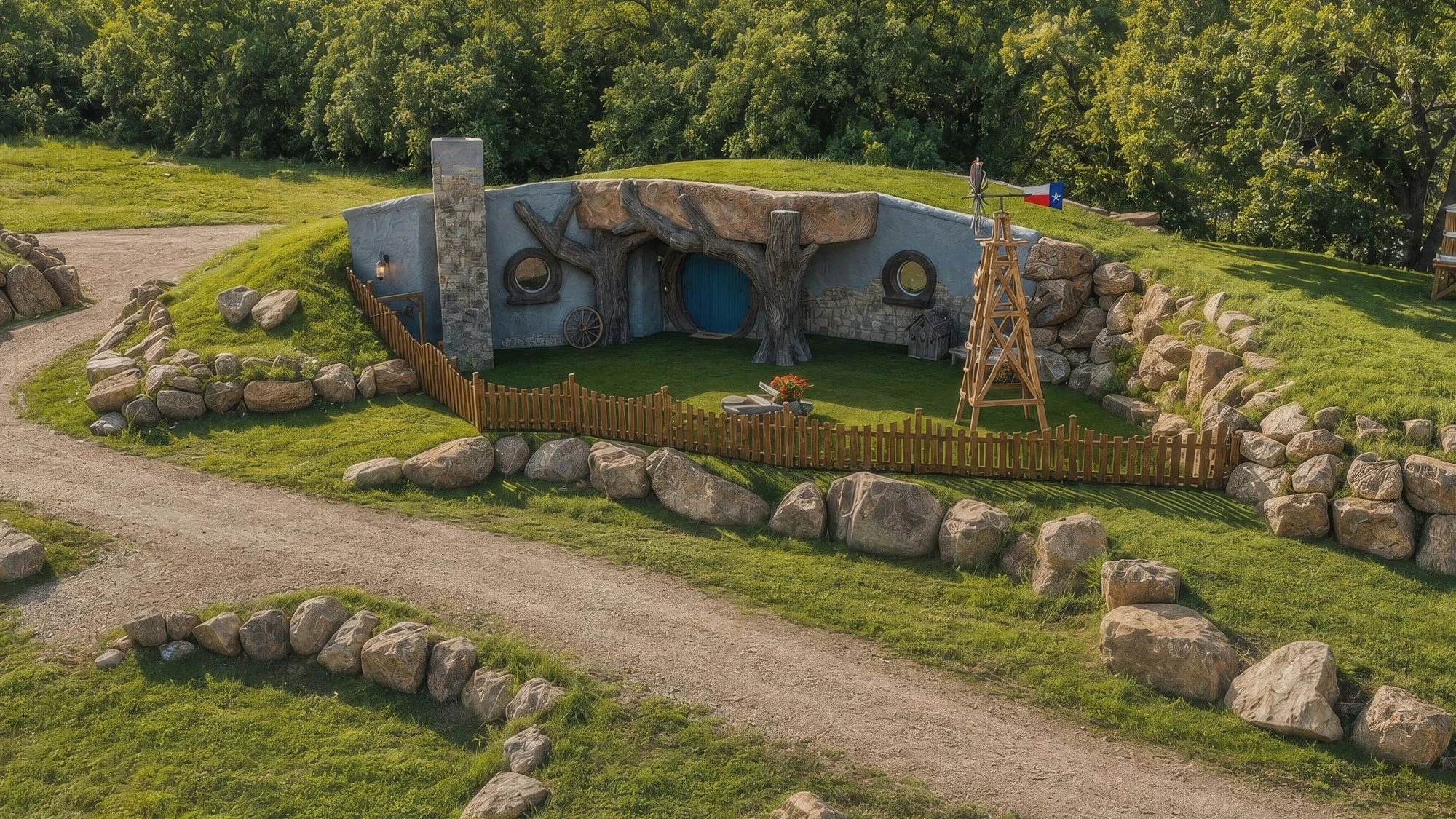
Mirador is about 1 hour 45 minutes from downtown Fort Worth. Stays have a two-night minimum, which leaves a full day for Thurber, Palo Pinto Mountains State Park or simply staying put. Open dates and rates change, so check the live calendar. Our Texas Shire planning guide covers groceries, check-in and what to pack.
Check dates for the Texas Shire Houses
Sources (checked October 29, 2026)
- Texas State Historical Association, Handbook of Texas Online: James C. Maroney, "Thurber, TX" (revised Aug. 12, 2020); William R. Hunt, "Mingus, TX"
- W.K. Gordon Center, Tarleton State University: Plan Your Visit (hours, admission, directions); Ken Jones, Ph.D., W.K. Gordon Center and the History of Thurber
- Smokestack Restaurant: Hours and Our History
- Mirador: Texas Shire Houses, FAQ; booking listings and live calendars (two-night minimum)
- Drive estimate: OSRM routing, downtown Fort Worth to Mirador (about 74 miles, about 1 hour 45 minutes)
Museum and restaurant hours and fees are from each venue's website on October 29, 2026. Confirm before you go, especially around holidays.